Guide
Why Oven Temperature Matters: The Science Behind Baking
Three chemical reactions in a cake all start at different temperatures. Here is what a 25-degree drift actually does to them, how to measure your oven, and when drift means the appliance needs service.
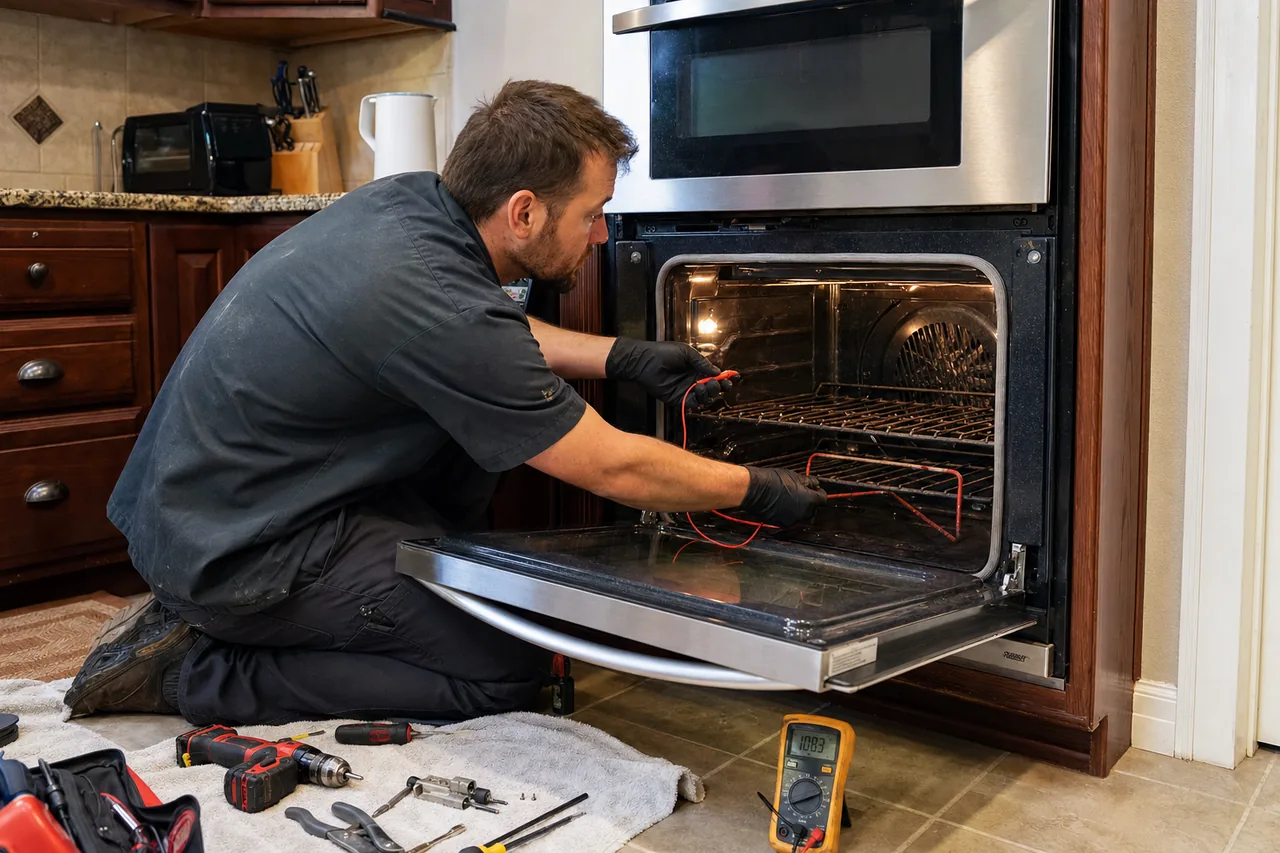
People bring us ovens that are “fine” because they roast and braise perfectly well, and mention almost in passing that the baking has gone wrong. That combination is diagnostic in itself. A roast forgives a 30-degree error because the meat is cooked to an internal temperature and the cook is watching it. A cake does not forgive anything, because a cake is three separate chemical reactions that each begin at their own temperature and have to finish in the right order.
Three reactions, three thresholds
Steam and gas expansion — from about 140°F. As the batter heats, water turns to steam and the carbon dioxide released by baking powder or soda expands. This is the rise, and it happens early, while the structure is still liquid enough to move.
Protein set and starch gelatinisation — roughly 150°F to 180°F. Egg proteins coagulate and starch granules absorb water and swell. This is the moment the batter stops being a liquid and becomes a solid that will hold whatever shape the rise gave it.
Maillard browning and caramelisation — from about 300°F at the surface. Sugars and amino acids react; sugars break down on their own. This is colour and flavour, and it happens only on the outside, where the surface is dry enough to exceed the boiling point of water.
The order is everything. Rise, then set, then brown. Every classic baking failure is that order coming apart.
What drift actually does
An oven running 25°F cool. The rise phase stretches out because the batter takes longer to reach the temperatures that generate steam and gas. But the structure is also slower to set, so the cake keeps rising into a batter that cannot yet hold it — and then collapses in the centre as the gas escapes before the protein has coagulated. The surface never gets hot enough for good browning within the recipe’s time, so the cook leaves it in longer, and the crumb dries out while the top stays pale. Pale, dry, sunken in the middle: that is a cool oven, near enough every time.
An oven running 25°F hot. The outside sets and browns before the inside has finished rising. A crust forms over a centre still generating steam, which has to go somewhere — so it cracks the top, or domes it hard, or tunnels through the crumb. Cookies spread less because the fat sets before it has spread. Dark edges and a raw centre: that is a hot oven.
An oven that swings. Some drift is normal — a thermostat cycles the element on and off, so the temperature oscillates around the setpoint by 10 to 25 degrees depending on the design. What is not normal is a swing wide enough to cross a threshold. If the cycle takes the cavity from 325°F to 400°F and back, the surface browns during every high phase whether or not the interior is ready.
Measuring your own oven
Ten minutes, one oven thermometer, no tools.
- Hang a dial or digital oven thermometer from the centre rack, in the middle of the cavity. Not on the floor, not against a wall.
- Set the oven to 350°F and leave it alone for a full 20 minutes after the preheat tone. The tone usually sounds when the air reaches temperature, which is well before the cavity walls and racks have — this is why the first tray often behaves differently from the second.
- Read the thermometer without opening the door, through the glass.
- Read it again every five minutes for half an hour, and write the numbers down.
You now have two separate facts: the average, which tells you about calibration, and the spread between the highest and lowest readings, which tells you about control.
A 10 to 15 degree average error is common and correctable. A 50 degree error, or a spread wider than about 50 degrees, is a fault rather than a calibration issue.
Calibration versus a fault
Most premium wall ovens and ranges allow an offset to be entered in the control — commonly by holding the bake pad until the display shows an adjustment value. Your manual has the sequence for your model. That offset corrects a consistent average error, and it is worth doing.
What an offset cannot correct:
- A drifting sensor. The oven’s temperature probe is a resistance sensor, and as it ages its resistance curve shifts. The control is reading it faithfully and still getting the wrong number. An offset masks this at one temperature and leaves it wrong at every other.
- A failing bake element or igniter. An element with a break, or a gas igniter too weak to open the safety valve promptly, makes the oven slow to recover after the door opens. The average may look acceptable; the spread will not be.
- A door that no longer seals. Hinge springs weaken and the gasket hardens, particularly on heavily used ranges. Heat leaks from the top of the door, the cavity stratifies, and the top of whatever is baking cooks differently from the bottom.
- A convection fan that has stopped. In a convection oven, moving air is what makes the cavity uniform. With the fan stalled, the setpoint is still reached and the distribution is ruined.
The test that separates these: if the average is wrong but the spread is tight, calibrate. If the spread is wide, something has failed and calibration will not help.
Two things specific to Manhasset kitchens
Much of the housing stock in 11030 is pre-war, repeatedly renovated, and the ovens are frequently installed in openings that were framed for something smaller. Two consequences show up in the baking.
The first is clearance. A wall oven needs its specified air gap to vent, and in a tight retrofit that gap is sometimes taken by joinery. The cavity runs hot, the electronics run hotter, and the thermostat fights the installation rather than the load.
The second is levelling. A range that is out of level by a small amount tilts every cake in it, and on an old floor that has settled — common in the Strathmore-era houses — this is usually the floor rather than the appliance. A cake consistently higher on one side is a levelling problem, not a thermostat problem, and a spirit level on the centre rack will tell you in seconds.
When to stop adjusting and call
Call when the spread is wide, when the oven takes a long time to recover after the door has been opened, when the top and bottom of the cavity differ by more than about 25 degrees, when a convection fan is silent, or when an error code appears on the display.
Call (475) 268-8998. The diagnostic is $95, credited toward the repair. We test the sensor’s resistance against its specification and map the cavity temperature rather than trusting the display, so the answer is which part has drifted — not a guess. Repairs are backed by a 1-Year Parts & Labor Warranty.
Before you call, write down your thermometer readings. Thirty minutes of numbers from your own oven is the single most useful thing you can hand a technician.